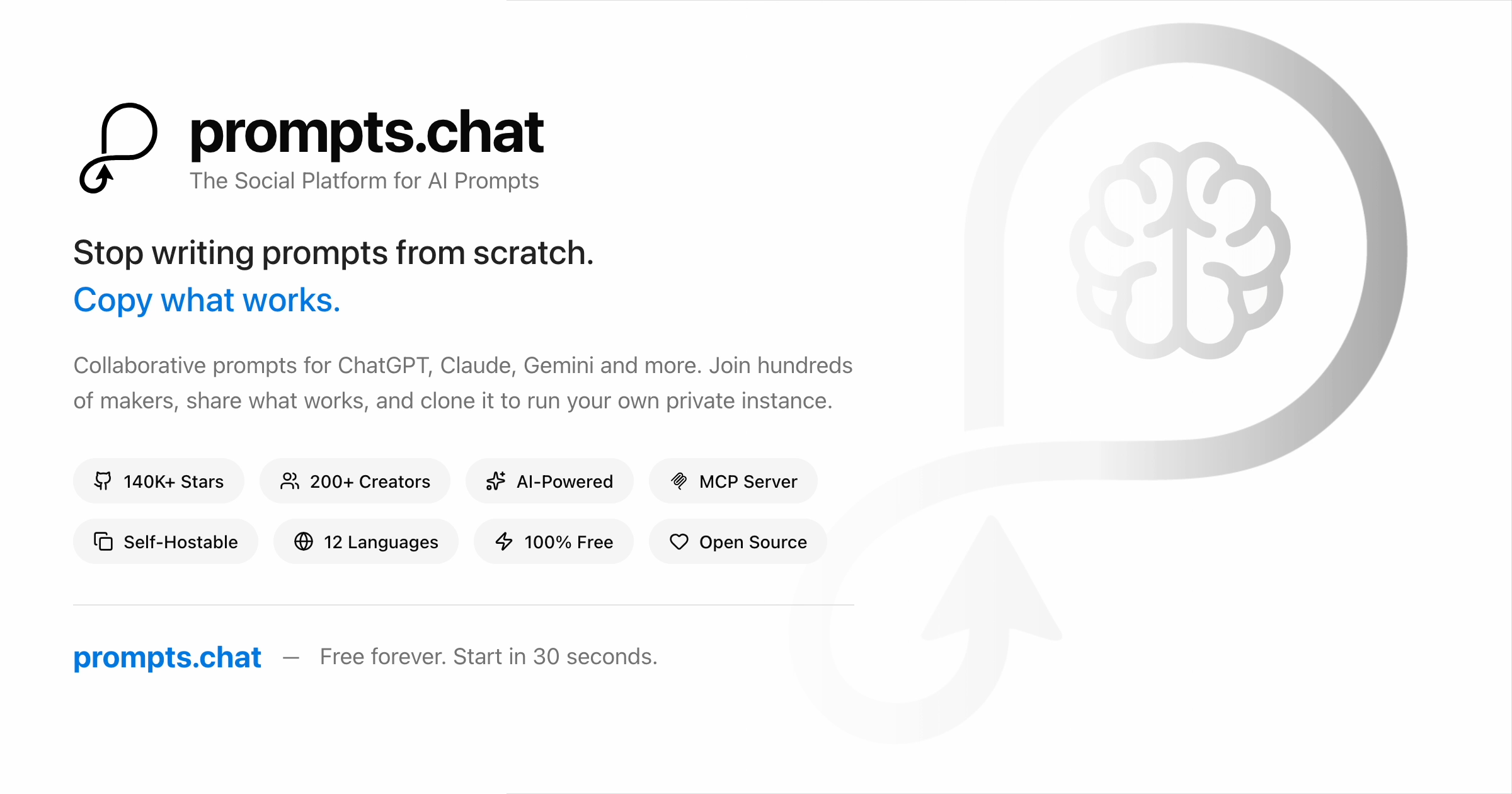

The growing field of artificial intelligence, particularly large language models (LLMs), has introduced a new engineering challenge: prompt engineering. An LLM's output effectiveness often depends directly on the quality and precision of its input prompt. As developers increasingly integrate LLMs into their applications, a systematic approach to discover, share, and manage these essential instructions has become important. prompts.chat is an important, community-driven solution to this problem, offering a centralized hub for high-quality, pre-tested prompts.
With 170,490 stars on GitHub, prompts.chat is a significant project. This large star count shows strong community validation and widespread adoption, making it a de facto standard and an essential resource for anyone working with LLMs. The project addresses a common challenge for developers, researchers, and AI enthusiasts.
This article examines prompts.chat's core philosophy and its architectural decisions. It walks through a use-case scenario for a developer, describes its tech stack, and provides a guide for self-hosting and extending the project. Finally, it details the process for contributing to this influential open-source initiative, giving you the technical insights needed to use and shape its future.
The Core Philosophy: Explaining the Why
prompts.chat, formerly Awesome ChatGPT Prompts, evolved from a pattern common in the open-source community: the "awesome list." It began as a static markdown file, a curated collection of prompts. However, the maintainers realized that a static list could not scale with the rapidly accelerating pace of LLM innovation and community contribution. The core philosophical shift transformed a flat, read-only list into a dynamic, searchable, and easily contributable platform. This move was driven by understanding prompt engineers' evolving needs.
A problem the maintainers explicitly chose not to solve was executing or testing prompts within the platform itself. prompts.chat is not an LLM sandbox, a fine-tuning environment, or an API wrapper. Its scope focuses on prompt discovery, sharing, and collection. This decision to limit scope has implications for its design, enabling a lightweight, high-performance architecture that prioritizes accessibility and ease of deployment. By deferring prompt execution to external LLM APIs or developer-specific environments, prompts.chat avoids the complexities of integrating with diverse LLM providers, managing API keys, or handling computational resources, which keeps the project lean and maintainable.
This design choice shows a trade-off: simplicity and self-hostability over extra features. The project's commitment to being "Free and open source - self-host for your organization with complete privacy" is central. This implies an architecture designed for minimal server-side dependencies, allowing deployment as a static site or with a lightweight server, ideally on commodity hardware or serverless platforms. The trade-off means it does not offer interactive prompt testing, version control for prompt evolution (beyond Git's inherent capabilities), or complex user authentication systems natively. These features, though potentially useful, would significantly increase operational overhead and compromise the core value proposition of easy self-hosting and privacy.
The project's philosophy contrasts with many commercial prompt marketplaces or private internal wikis. Proprietary platforms often aim to monetize prompts, control access, or lock users into specific ecosystems. prompts.chat, by contrast, champions open knowledge sharing, community collaboration, and user autonomy. It uses the collective intelligence of the open-source community to curate a diverse and high-quality repository of prompts, making this knowledge freely available. This democratic approach to prompt engineering directly challenges proprietary models that could otherwise silo LLM interaction patterns.
Regarding its defaults, prompts.chat enforces a structured format for prompt submissions. Each prompt follows a clear schema: a title, a concise description, the actual prompt text, an author, and a set of tags. This structured approach is a deliberate design choice to ensure consistency, discoverability, and utility. Without these defaults, the collection could quickly become unwieldy, making it difficult for users to find relevant prompts or for the community to maintain quality. The tagging system, in particular, enables sophisticated filtering and categorization, reflecting the multifaceted nature of prompt engineering across various domains and LLM applications.
A Practical Use-Case Walkthrough
Consider a developer tasked with integrating a generative AI feature into a new customer support system. Their goal is to automatically draft initial responses to common inquiries, saving agent time. Crafting effective, consistent prompts for nuanced customer service scenarios can be time-consuming and prone to trial and error. This developer needs a robust "system prompt" that instructs the LLM on its role, tone, and output format.
Their starting state is a basic application skeleton with an API endpoint ready to call an LLM, but without a finely tuned prompt, the LLM's responses are often generic, off-topic, or inconsistent with the desired brand voice. Manually iterating on prompts risks introducing bias or missing key instructions.
prompts.chat provides an immediate, practical solution:
- Identify the need: The developer recognizes the need for a "customer support bot" persona prompt.
- Navigate and Search: They visit
prompts.chatand use the search bar or tag filters. They might search for "customer support," "chatbot," "assistant," or "system prompt." - Discover and Evaluate: They browse the results, looking at prompt titles and descriptions. One prompt, perhaps titled "Act as a Customer Support Agent," catches their eye. They click into it to read the full prompt text and any associated details or usage tips. They evaluate its tone (helpful, empathetic, professional) and its explicit instructions (e.g., "always refer to documentation," "offer solutions").
- Copy and Integrate: Satisfied with the prompt's quality and relevance, they use the "Copy" button to grab the entire prompt text.
- Implement in Application: They integrate this copied prompt into their application's LLM API call, specifically as the
systemmessage to establish the LLM's persona.
The end result is a significantly accelerated development process. Instead of spending hours crafting and testing various prompt iterations, the developer quickly uses a community-validated prompt, allowing them to focus on the application logic rather than prompt details. This reduces time-to-market for the AI feature and ensures a higher quality, more consistent initial output from the LLM, which can then be further fine-tuned with specific use-case examples as user messages.
// Example: Integrating a prompts.chat system prompt into a Next.js API route or client-side logic


// This snippet assumes an API route or client-side function that communicates with an LLM provider.


const customerSupportSystemPrompt = `


You are an empathetic and professional customer support agent for a SaaS company named "InnovateLink".


Your primary goal is to assist users with their product inquiries, troubleshoot common issues, and guide them towards solutions using clear, concise, and friendly language.


Always prioritize providing helpful information and directing users to the official documentation or knowledge base when appropriate.


If a query requires account-specific details or advanced technical support, kindly inform the user that you are an AI assistant and recommend contacting a human agent via email or live chat, providing the contact information.


Maintain a positive and supportive tone.


`;


async function getCustomerSupportResponse(userQuery: string) {


  try {


    const response = await fetch('/api/llm-proxy', { // Assuming a local API route to proxy to LLM


      method: 'POST',


      headers: { 'Content-Type': 'application/json' },


      body: JSON.stringify({


        messages: [


          { role: 'system', content: customerSupportSystemPrompt },


          { role: 'user', content: userQuery },


        ],


        model: 'gpt-4o', // or 'claude-3-haiku-20240307', 'gemini-pro'


        temperature: 0.7, // Adjust for creativity vs. consistency


      }),


    });


    if (!response.ok) {


      throw new Error(`LLM API error: ${response.statusText}`);


    }


    const data = await response.json();


    return data.choices[0].message.content; // Accessing the LLM's response


  } catch (error) {


    console.error("Error getting LLM response:", error);


    return "I apologize, but I'm having trouble processing your request at the moment. Please try again later or contact our human support team.";


  }


}


// Example usage within a React component or serverless function:


/*


async function handleUserChatInput(input: string) {


  const llmResponse = await getCustomerSupportResponse(input);


  // Update UI with llmResponse


}


*/
Under the Hood: The Actual Tech Stack
Looking at the technical architecture of prompts.chat shows a pragmatic, modern web development stack optimized for performance, scalability, and ease of deployment. The project primarily uses Next.js, a React framework, built with TypeScript. This choice allows for robust, type-safe development and uses Next.js's features like static site generation (SSG) and file-system-based routing. The Primary Language: HTML reported indicates Next.js's output, as SSG produces pre-rendered HTML files that are then hydrated with JavaScript for interactivity, rather than indicating raw HTML development.
The project's content, the prompts themselves, is structured in a straightforward, transparent manner: as Markdown files within the repository. A prompts/ directory contains individual .md files, each representing a unique prompt. This direct approach is a key architectural decision that aligns with the project's goals of community contribution, version control (via Git), and static site generation.
Each Markdown file uses YAML frontmatter at the top to define metadata for the prompt. This frontmatter includes fields such as title, description, prompt (the actual prompt text), author, and tags. The prompt field often uses a multiline string format (YAML block scalar) to accommodate lengthy and complex instructions for LLMs. This structure allows Next.js to easily parse the prompt content and metadata during the build process, enabling features like search, filtering by tags, and dynamic rendering of individual prompt pages.
For example, a typical prompt file structure looks like this:
---

title: Act as a JavaScript Console

description: I want you to act as a JavaScript console. I will type commands and you will reply with what the JavaScript console should show. I want you to only reply with the console output inside one unique code block, and nothing else. do not write explanations. do not type commands unless I instruct you to do so. when i need to tell you something in english, i will do so by putting text inside curly brackets {like this}.

prompt: I want you to act as a JavaScript console. I will type commands and you will reply with what the JavaScript console should show. I want you to only reply with the console output inside one unique code block, and nothing else. do not write explanations. do not type commands unless I instruct you to do so. when i need to tell you something in english, i will do so by putting text inside curly brackets {like this}.

author: f

tags: [javascript, console, programming, coding, cli]

---
The build and deployment approach relies on Next.js's Static Site Generation (SSG) capabilities. During the build process (next build), Next.js reads all Markdown files in the prompts/ directory, parses their frontmatter and content, and generates a static set of HTML, CSS, and JavaScript files. This pre-rendering means the entire prompts.chat website can be served from any static file host or Content Delivery Network (CDN), making it fast, scalable, and resilient. This approach is fundamental to fulfilling the "self-host for your organization with complete privacy" promise, as there are minimal runtime dependencies on a complex backend server; the core functionality is delivered client-side. The project could be deployed to platforms like Vercel (often a default for Next.js projects), Netlify, GitHub Pages, or any simple web server.
Regarding its license, while the project description states "Free and open source," the reported license is NOASSERTION. For FOSS projects, it is standard practice to explicitly choose a well-known open-source license (like MIT, Apache 2.0, or GPL) to define terms of use, modification, and distribution. The NOASSERTION status means that, while the code is publicly available, the legal terms for its reuse are not explicitly stated by a standard license, which is a point of awareness for developers considering deep integration or commercial use.
Building or Extending It: A Practical Guide
Getting prompts.chat running locally, or extending it for your team's specific needs, is straightforward due to its Next.js foundation. The process involves cloning the repository, installing dependencies, and starting the development server.
First, you need Node.js and a package manager (npm, yarn, or pnpm) installed on your system.
# Clone the repository

git clone https://github.com/f/prompts.chat.git


# Navigate into the project directory

cd prompts.chat


# Install dependencies using pnpm (recommended by many Next.js projects),

# or npm/yarn if you prefer.

pnpm install

# Or: npm install

# Or: yarn install


# Start the development server

pnpm dev

# Or: npm run dev

# Or: yarn dev
Once pnpm dev is running, the application is accessible in your web browser, typically at http://localhost:3000. You can now navigate the site, search prompts, and interact with it as if it were the live version.
Extending or customizing prompts.chat for your team usually involves adding new, internal-specific prompts that might not be suitable for public contribution, or modifying existing ones to better suit your organizational style. Given the Markdown-based content structure, this is simple.
To add a new prompt, create a new .md file in the prompts/ directory. Ensure the filename is descriptive and in kebab-case. The content of this file must follow the existing frontmatter structure.
Here is an annotated code snippet showing how to add a custom prompt for an internal team's specific LLM use case:
# prompts/internal-legal-compliance-check.md

---
# The 'title' field will be displayed prominently on the website.
title: Legal Compliance Review Assistant

# The 'description' provides a brief overview, used in search results and listings.
description: A specialized system prompt for reviewing documents against internal legal compliance guidelines. It identifies potential risks and areas for revision.

# The 'prompt' field contains the actual instructions for the LLM.
# Use a YAML block scalar (indicated by the pipe `|`) for multi-line content,
# which preserves newlines and formatting, critical for complex prompts.
prompt: |
  You are an AI assistant specialized in legal compliance review for "Acme Corp.".
  Your task is to analyze provided text documents for adherence to our internal legal guidelines.
  Specifically, check for:
  1.  Unauthorized use of copyrighted material.
  2.  Disclosure of confidential "Acme Corp." information.
  3.  Misleading or false statements regarding product capabilities.
  4.  Language that could be construed as discriminatory or non-inclusive.
  For each identified issue, provide:
  -   The specific problematic phrase or sentence.
  -   The relevant "Acme Corp." guideline it violates (e.g., "Confidentiality Policy, Section 3.1").
  -   A suggested revision to comply with the guideline.
  If no issues are found, state "Document appears compliant with current guidelines."

# The 'author' can be an individual or a team name for internal prompts.
author: AcmeCorpLegalTeam

# 'tags' are crucial for discoverability and filtering. Use existing tags or add new ones.
tags: [internal, legal, compliance, review, document-analysis, policy]
---
After saving prompts/internal-legal-compliance-check.md, the new prompt might not immediately appear in your browser, even if your development server is running. While Next.js has fast refresh for code changes, adding new static content files, especially those used for SSG data sources, often requires a full restart of the development server (pnpm dev) to re-index the content and rebuild the necessary pages. Restart your dev server after adding new Markdown files to the prompts/ directory to avoid confusion.
Contributing to the Project: The Open-Source PR Process
Contributing to prompts.chat helps the LLM community and refines your prompt engineering skills. The project maintains a clear process to ensure quality and consistency.
Step 0: When to Open an Issue vs. When to Go Straight to a PR
Before writing any code or content, consider your contribution's scope:
- Open an Issue first (before a PR): If your contribution involves significant structural changes (e.g., proposing new features, modifying core components), reporting a bug that requires discussion, suggesting new category tags, or any change that would benefit from community input or maintainer approval before implementation. This prevents wasted effort on changes that might not align with the project's direction.
- Go straight to a PR: For straightforward contributions such as:
- Correcting typos or grammatical errors in existing prompts or descriptions.
- Refining the wording of an existing prompt to make it clearer or more effective (provided the core intent remains).
- Adding an entirely new prompt that adheres to the existing structure and contributes significant value.
Step 1: Fork, Clone, Install
To begin, you need your own copy of the repository:
# Fork the repository on GitHub (visit github.com/f/prompts.chat and click 'Fork').

# Clone your forked repository to your local machine:
git clone https://github.com//prompts.chat.git

# Navigate into the project directory:
cd prompts.chat

# Install project dependencies:
pnpm install # Or npm install / yarn install

# Start the development server to ensure everything is working:
pnpm dev
Step 2: Locate the Correct File to Edit and Follow Conventions
Most contributions involve the prompts/ directory.
- Adding a new prompt: Create a new Markdown file within
prompts/, ensuring the filename is inkebab-caseand descriptive (e.g.,act-as-a-devops-engineer.md). - Editing an existing prompt: Navigate to the specific
.mdfile you wish to modify. - Content Conventions:
- Each prompt file must include YAML frontmatter at the top, defining
title,description,prompt,author, andtags. - The
promptfield should contain the LLM instruction, ideally using a multi-line string. tagsshould be relevant and specific. Consider reusing existing tags for consistency.- Ensure consistent formatting; use proper markdown syntax for any bolding or lists within descriptions or prompts.
- Each prompt file must include YAML frontmatter at the top, defining
Step 3: Quality Bar for Contributions
Maintainers prioritize quality and utility. When submitting a prompt:
- Utility: Is the prompt useful and applicable to a wide range of developers or users?
- Clarity: Is the prompt's instruction clear, unambiguous, and effective in guiding the LLM?
- Originality: Does it offer distinct value compared to existing prompts, or is it a significant improvement over a similar one? Avoid submitting near-duplicates.
- Testing: Have you tested the prompt with an LLM (e.g., ChatGPT, Claude, Gemini) to verify its effectiveness? Include observations in your PR description.
- Adherence to Format: Does your submission strictly follow the Markdown frontmatter structure and naming conventions?
Step 4: Open a PR - The Title, Description, and Post-Merge
Once your changes are ready and tested:
- Create a new branch:
git checkout -b feat/add-new-devops-prompt - Add and commit your changes:
git add .thengit commit -m "feat: Add new 'Act as a DevOps Engineer' prompt"(Use conventional commit messages if applicable). - Push your branch to your fork:
git push origin feat/add-new-devops-prompt - Open a Pull Request: Go to your fork on GitHub and follow the prompt to open a new PR against the upstream
f/prompts.chatrepository. - PR Title and Description:
- Title: Make it descriptive and concise, e.g., "feat: Add new 'Act as a Marketing Strategist' prompt" or "fix: Grammar correction in 'Act as a Data Scientist' prompt".
- Description: Use the provided PR template if one exists, or clearly explain:
- What problem your contribution solves.
- How you've addressed it.
- Any testing performed and the results.
- Link to any relevant issues.
- Post-Merge: Maintainers will review your PR, offer feedback, or request changes. Once accepted, your contribution will be merged, and typically deployed automatically, becoming available to the entire
prompts.chatcommunity. Be prepared to engage constructively with feedback.
Wrapping Up
prompts.chat is an important project in LLM development, directly addressing the need for effective prompt engineering. Its community adoption shows its utility as a high-signal resource for anyone integrating AI into their workflows.
Here are three actionable takeaways for developers:
- Use Collective Intelligence for LLM Integration: Before crafting prompts from scratch, consult
prompts.chat. Its vast, community-curated collection of prompts can accelerate development cycles, providing battle-tested instructions that save time and improve LLM interactions in your applications. - Prioritize Self-Hostability for Privacy and Control: The Next.js and Markdown-based architecture of
prompts.chatmakes it easy to self-host. For organizations dealing with sensitive data or requiring strict control over their prompt repositories, deploying a private instance ensures complete privacy and autonomy, circumventing the need for proprietary platforms. - Contribute to Shape the Future of Prompt Engineering: As an open-source project,
prompts.chatthrives on community contributions. Whether it is refining existing prompts, adding new ones, or proposing architectural improvements, contributing helps standardize prompt engineering practices and ensures the platform remains a cutting-edge resource for the AI community.
prompts.chat is more than a list of instructions; it shows the power of open collaboration in tackling new technical frontiers. Explore its depths, contribute your expertise, and integrate its power into your development workflow.
Discover prompts.chat and its community at https://fossy.dev/f/prompts.chat.